Every Sunday, in my Sunday Reading series, I introduce an article that has caught my attention. This week’s article is not only about domestic cats in the Roman world. It is also a very entertaining and instructive example of how an archaeological identification can—and sometimes should—be questioned.
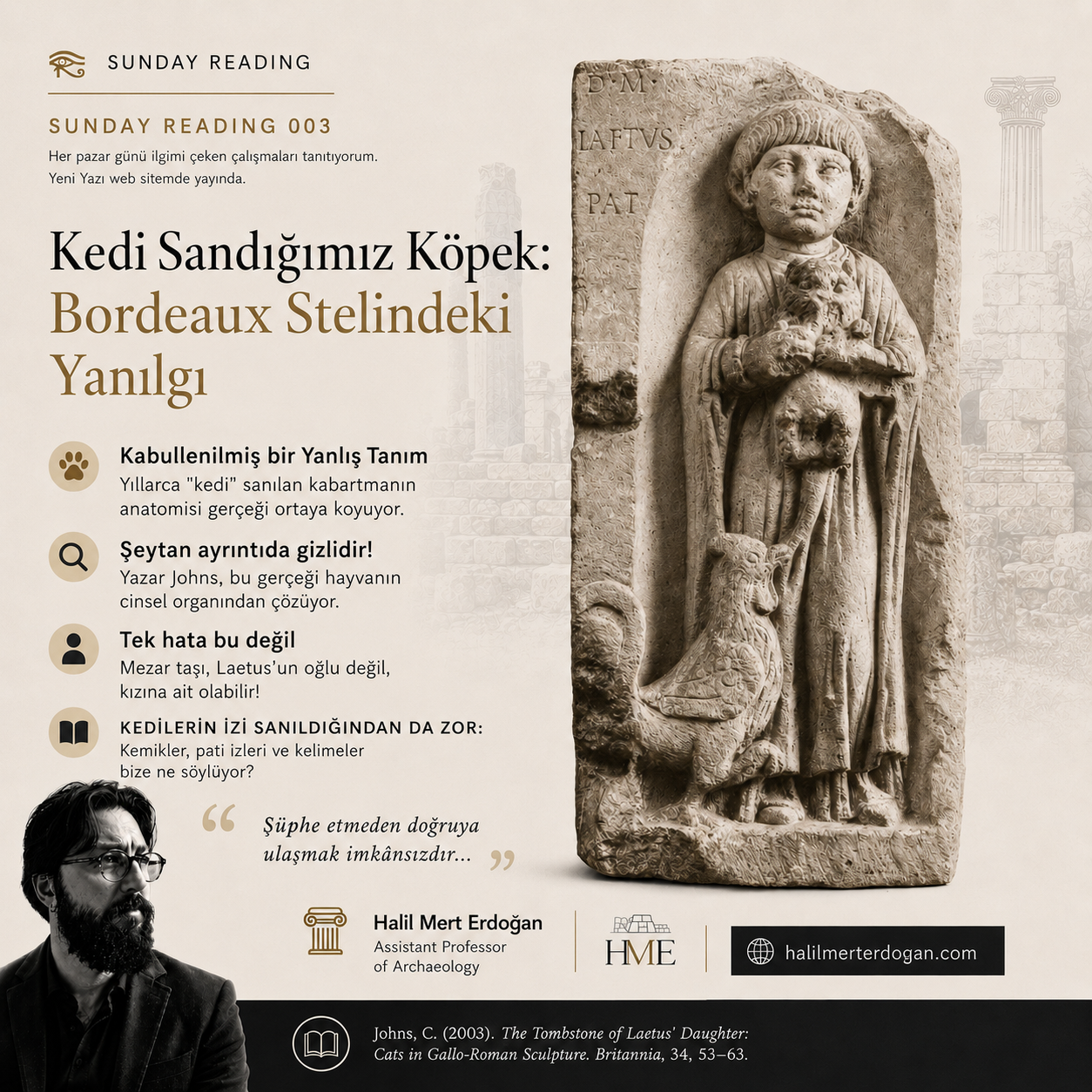
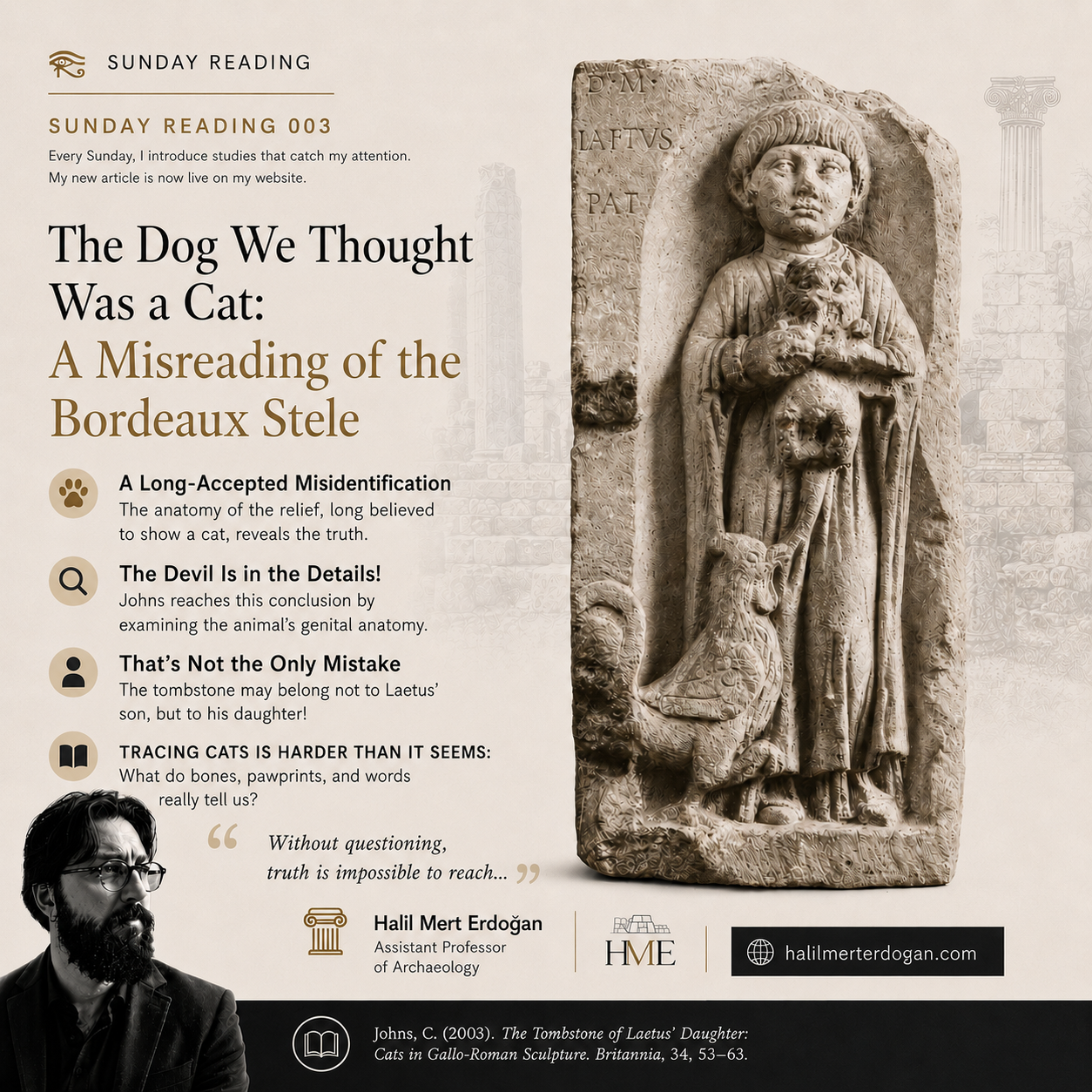
You probably would not be surprised to hear that cats appear on Roman funerary monuments for children. In fact, a famous tombstone found in Bordeaux and probably dating to the second century AD was accepted for almost two centuries as one of the best examples. It shows a young child holding a small animal, with a large cockerel standing at the child’s feet. Because of its pointed ears, large eyes, small body, and long tail, scholars identified the animal as a cat for many years.
Catherine Johns, in her article The Tombstone of Laetus' Daughter: Cats in Gallo-Roman Sculpture, re-examines this long-standing interpretation and reaches a surprising conclusion:
The animal is not a cat. It is a dog.
And the evidence is much simpler than a complicated iconographic interpretation: the animal’s anatomy.
The animal is held with its belly facing the viewer, and it is clearly male. Johns points out that the sculptor represented its sexual anatomy quite clearly. The testicles are between the hind legs, while the penis extends forward beneath the body. This is the anatomy of a male dog, not a male cat. In male cats, the testicles are located close to the anus, just below the tail, and the penis would not normally be visible in this position. In other words, an image that had been used for years as evidence for a Roman domestic cat actually shows clear canine anatomy.
This is perhaps the most entertaining part of the article. Johns is surprised that so many scholars studied the monument without noticing this detail. She describes it as a good example of how incorrect information, when repeated often enough, can eventually become accepted as “fact.” Even more ironically, some of the scholars who identified the animal as a cat were themselves cat lovers. As Johns jokingly suggests, perhaps nobody wanted to look too closely at the animal’s “private parts.”
There is another mistaken identification on the Bordeaux tombstone. The monument has sometimes been described as the tombstone of “a boy named Laetus.” Johns re-examines both the inscription and the child’s clothing and jewellery and argues that the figure is most probably Laetus’ young daughter. She wears two bracelets, and her earlobes were drilled to hold metal earrings. Laetus, therefore, was probably not the child’s name but her father’s. The quality of the monument and the inscription also suggest that her father was a man of some wealth, although probably not a Roman citizen.
The wider discussion in the article shows how difficult it is to trace domestic cats in the Roman world. Finding cat bones is not enough, because distinguishing domestic cats from European wildcats, especially young animals, can be difficult. Even the presence of cat bones or paw prints at a Roman settlement does not prove that the animal was a pet. For this reason, many claims about domestic cats in the Roman period depend on evidence that is far less certain than it first appears.
Another interesting clue comes from language. Earlier Latin used felis/feles for small feline animals, while catus/cattus became more common in the Late Roman period. Modern words such as Italian gatto, French chat, English cat, German Katze, and Welsh cath are related to this word. Johns suggests that the spread of the word may have been connected with the spread of the domestic cat itself across the Roman Empire. It is not presented as definite proof, but it is a fascinating reminder that we can sometimes follow the history of animals not only through bones and images, but also through the history of words.
For me, however, the real value of the article is not simply about cats. It is about archaeological method. The fact that an object has been identified in the same way dozens of times in the literature does not automatically make that identification correct. Sometimes we do not need a new excavation, a new laboratory method, or sophisticated technology. Sometimes we simply need to look at the object again, carefully and without taking earlier interpretations for granted.
*
While reading this article, I thought of my dear professor, Prof. Dr. Fahri Işık. When we were first- and second-year students, he would project slides of sculptures he had been studying for years and ask us what we thought. Years later, when we asked him why he did this, he said something along these lines:
“If there is a mistake in something I have been looking at for years, after a while I may no longer be able to see it. A scholar must question himself—and allow himself to be questioned as well.”
It is impossible to reach the truth without doubt...
Have a good Sunday.
This Week’s Article
Johns, C. (2003). The Tombstone of Laetus' Daughter: Cats in Gallo-Roman Sculpture. Britannia, 34, 53–63.