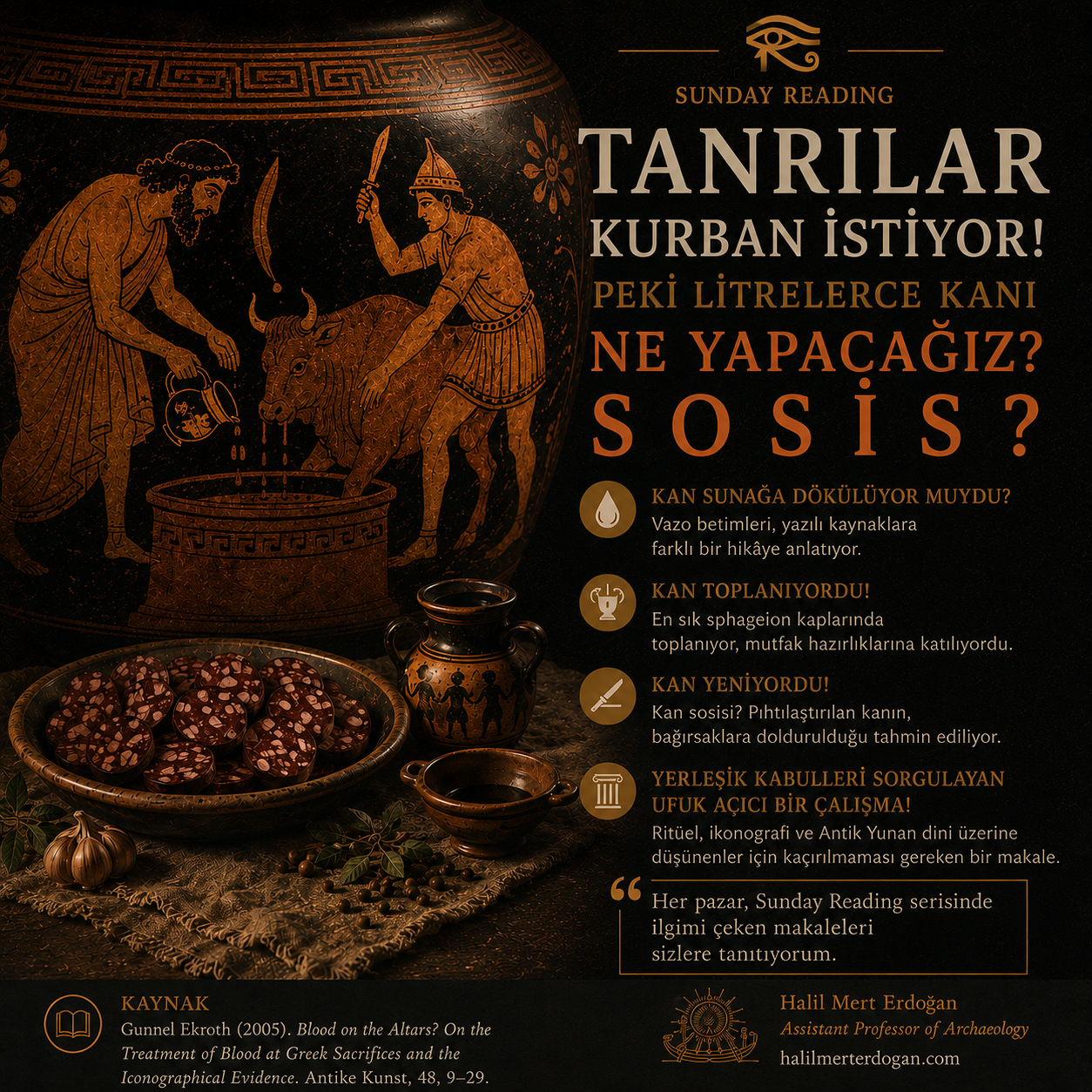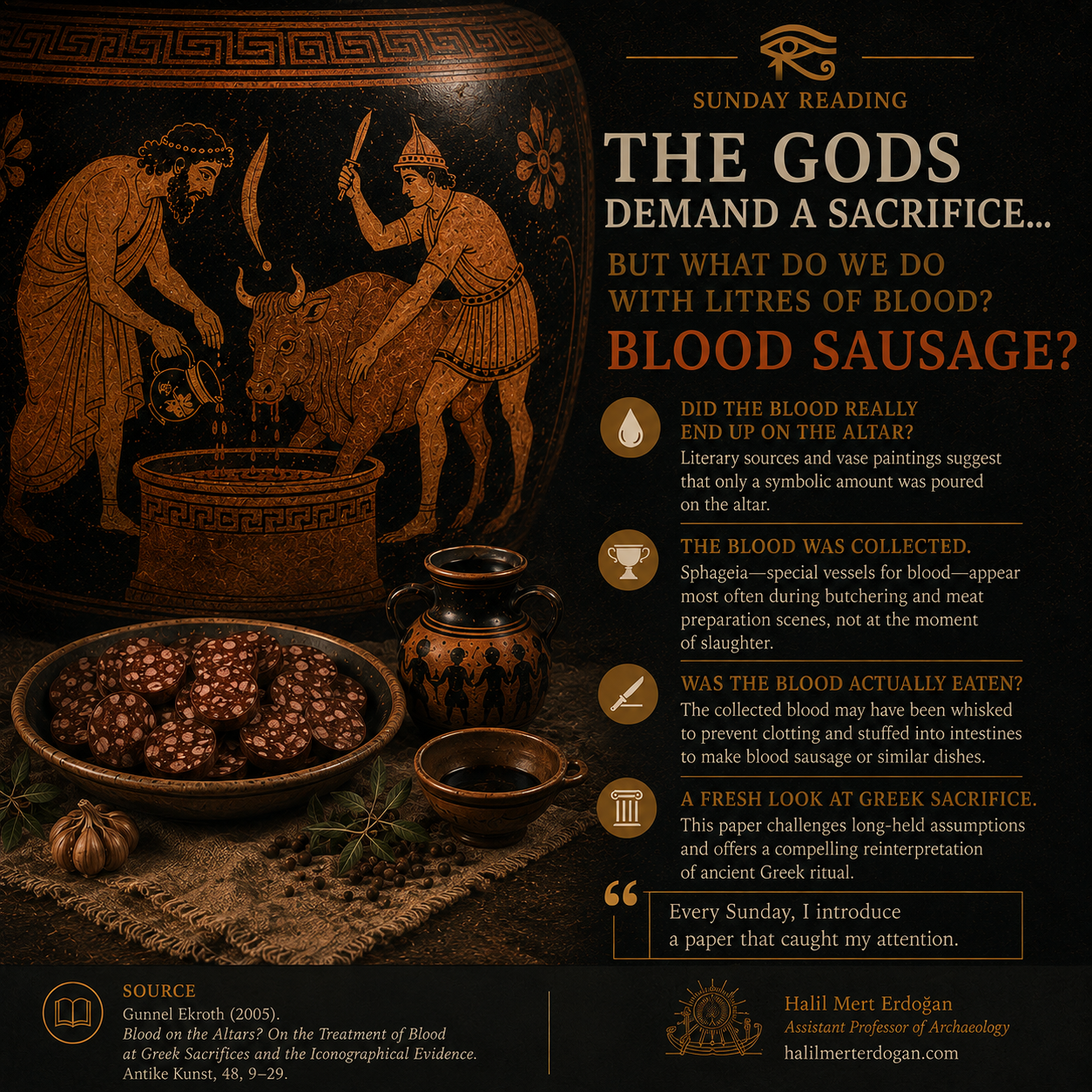
Every Sunday, I introduce an academic article that I find particularly interesting as part of the Sunday Reading series. This week, I would like to share a fascinating study that challenges some long-held assumptions about animal sacrifice in Ancient Greece.
When most of us think about Greek sacrificial rituals, we imagine the same scene: an animal is sacrificed, its blood is poured over the altar, and the offering is dedicated to the gods. In her article, Blood on the Altars? On the Treatment of Blood at Greek Sacrifices and the Iconographical Evidence, Gunnel Ekroth challenges this familiar picture. By combining written sources with hundreds of vase paintings, she argues that most of the animal's blood was probably not poured onto the altar. Instead, it was collected and may have been consumed by the participants.
One of the most fascinating parts of the article focuses on the depiction of altars in Greek vase paintings. If the blood had really been poured over the altar in large quantities, we would expect to see altars covered in blood. Surprisingly, this is not what the evidence shows. Most altars display only a few drops, thin lines, or small stains. According to Ekroth, this suggests that only a symbolic amount of blood was sprinkled on the altar during the ritual.
Even more interesting is the role of the vessel known as the sphageion, which was used to collect the blood. Rather than appearing in scenes showing the animal being killed, it is most commonly depicted in scenes where the meat is being cut up and prepared for cooking. The vessel is frequently shown alongside the mageiros, the butcher-cook responsible for preparing the sacrificial meal. For Ekroth, this iconographic association is unlikely to be accidental and may indicate that the blood became part of the meal rather than simply being discarded.
The article also offers an interesting observation about the way Greek artists chose to represent sacrifice. In ordinary animal sacrifices, blood is almost never shown spurting from the victim's throat. Instead, scenes with freely flowing blood are generally associated with human sacrifice or unusual mythological events. In other words, abundant blood seems to have been used as a visual language for exceptional and disturbing situations rather than for normal religious practice.
The part that made me think the most, however, concerns food culture. Ekroth suggests that the collected blood had to be stirred continuously to prevent it from clotting and may then have been used to prepare blood sausages or similar dishes. At first this sounds surprising, but traditions such as Blutwurst, which is still eaten today in Germany and several other European countries, remind us that this practice may also be understood as part of a long culinary tradition. Of course, this last observation is my own interpretation, but it was one of the first connections that came to mind while reading the article.
Ekroth's interpretation is certainly not the only view in the ongoing discussion of Ancient Greek religion. Nevertheless, her article offers a fresh perspective by bringing together written evidence and iconographic material. If you are interested in iconography, ritual, or Ancient Greek religion, this article is likely to make you reconsider some assumptions you may have taken for granted.
This Week's Reading
Ekroth, G. (2005). Blood on the Altars? On the Treatment of Blood at Greek Sacrifices and the Iconographical Evidence. Antike Kunst, 48, 9–29.